100 credits per request, whether it holds 1 or 5,000 keywords. CPC, competition and keyword difficulty are in the same response.pay per use€0.018billed per querypay per useGo to provider (new tab)
The Data API delivers keyword data, search results, backlinks, domain analyses, site audits and AI visibility. The Project API also controls rank tracking and projects in your SE Ranking account.
You buy credits either once as a balance (250,000 credits for €45, no expiry) or as an annual package from 12 million credits. For customers with an SE Ranking subscription there is an API add-on, and the Core and Growth plans already include a small allowance.
How this query is billed
100 credits per request, whether it holds 1 or 5,000 keywords. CPC, competition and keyword difficulty are in the same response.
Endpoint: POST /v1/keywords/export
That is what the API description says, and it is what was deducted from an account of my own on November 16, 2026.
Measured on my own account.
Limits
Data API: 10 requests per second, 1 per second during the trial
Project API: 5 requests per second
Up to 5,000 keywords per request for the keyword export
Prepaid balance: pay per use, minimum top-up €45.00250,000 credits per top-up. The balance does not expire.
Standalone: €180.00 per month with annual billing12 million credits per year, paid in advance, Data API only. Unused credits expire at the end of the year. Larger packages up to 120 million credits cost less per credit.
$0.06 per task in the standard queue, whether the task holds 1 or 1,000 keywords. CPC and competition are in the same response.pay per use$0.06about €0.055, billed per querypay per useGo to provider (new tab)
DataForSEO sells data through its API only: search results, keyword data, backlinks, on-page crawls and data on visibility in AI answers.
There is no subscription. You top up a balance from $50 and pay per query. The balance does not expire.
How this query is billed
$0.06 per task in the standard queue, whether the task holds 1 or 1,000 keywords. CPC and competition are in the same response.
Endpoint: keywords_data/google_ads/search_volume
The data comes from Google Ads. Live mode allows 12 requests per minute at most.
Live: $0.09 per 1,000 keywords
Costs as documented by the provider.
Limits
10,000 requests per minute
30 concurrent requests at most for Labs, Backlinks and OnPage
Up to 1,000 keywords or 1,000 result rows per task
DataForSEO Labs and Backlinks are available in live mode only
1 credit per result row, that is, per keyword. Keyword difficulty, CPC and competition are in the same response.2,000,000 keywords$0.25about €0.227, at full use of the allowance2,000,000 keywordsGo to provider (new tab)
The API delivers keyword, domain and backlink data from the Serpstat database, plus live search results, site audits and rank tracking.
The API is part of the Team, Team x2 and Agency plans. The Individual plan has no API access. The credits renew monthly. For large volumes of search results and search volume there are two separate prepaid products from $300.
How this query is billed
1 credit per result row, that is, per keyword. Keyword difficulty, CPC and competition are in the same response.
11 units per keyword: 1 for the keyword and 10 for the search volume. With CPC it is 12.181,818 keywords€1.92at full use of the allowance181,818 keywordsGo to provider (new tab)
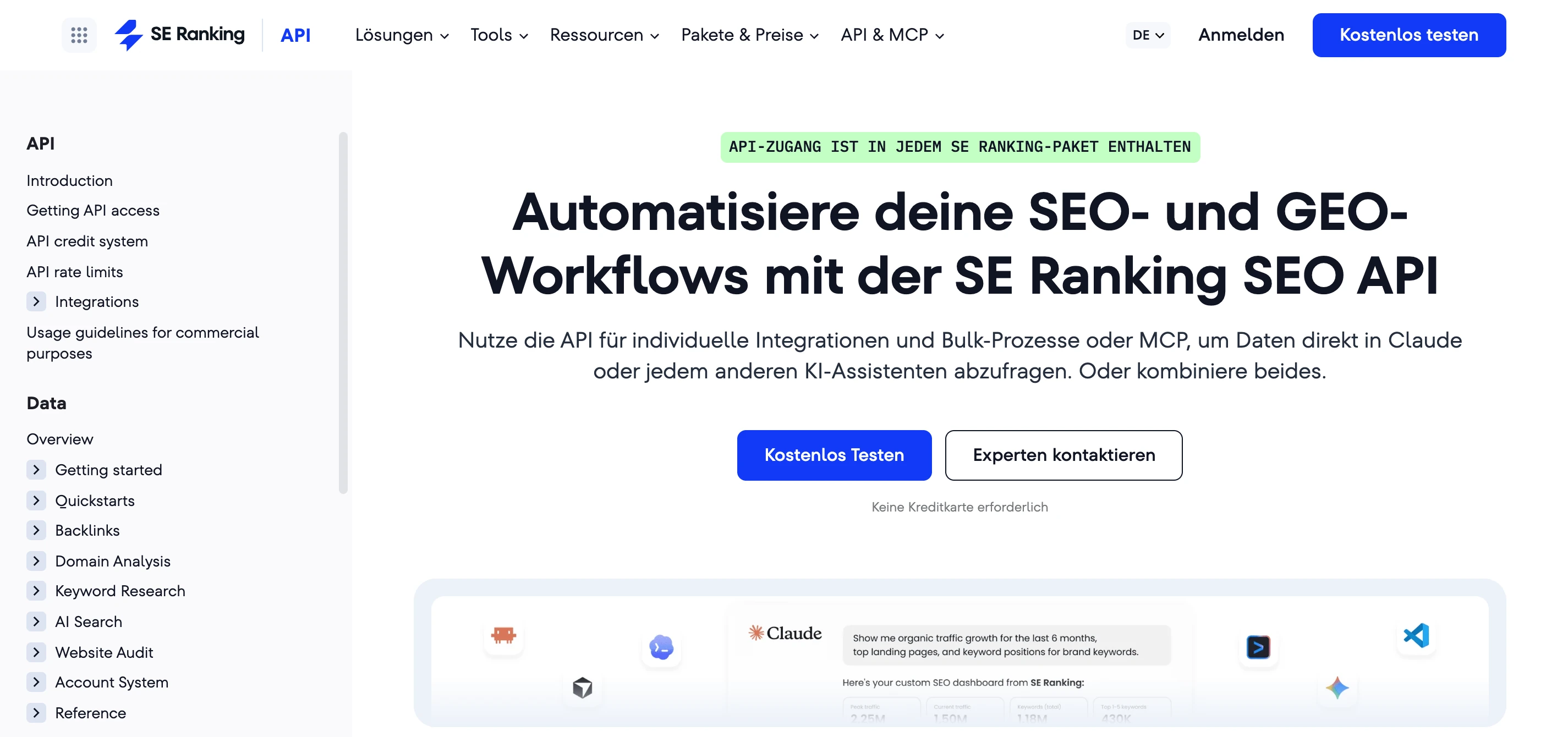
API v3 accesses the same data as Site Explorer, Keywords Explorer, Rank Tracker, Site Audit and Brand Radar.
The API is part of the Lite, Standard and Advanced plans. Every plan has a fixed monthly allowance of API units. You can only buy more units in the Enterprise plan.
How this query is billed
11 units per keyword: 1 for the keyword and 10 for the search volume. With CPC it is 12.
Endpoint: keywords-explorer/overview
Calculated from the documented billing formula.
Limits
60 requests per minute
100 (Lite), 250 (Standard) or 500 (Advanced) rows per query at most
20 units per keyword. Every request holds exactly one keyword and returns search volume, CPC and keyword difficulty together.1,000,000 keywordsfrom $1.30about €1.18, at full use of the allowanceplus Advanced plan (price on request)1,000,000 keywordsGo to provider (new tab)
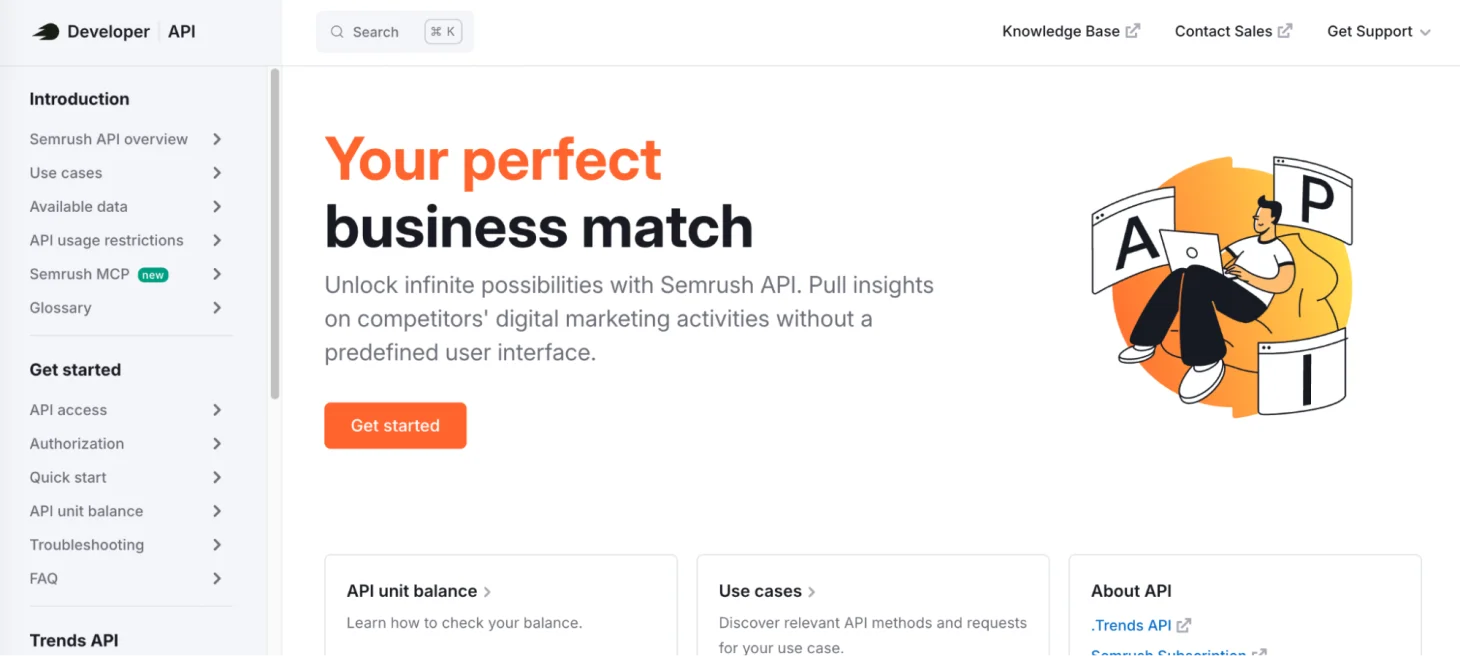
The SEO API delivers keyword, domain and backlink data from the Semrush database. The Projects API controls Position Tracking and Site Audit.
You need two things: a plan with API access, which Semrush lists on its pricing page only as Advanced with a price on request, and on top of that a monthly package of API units from $100. The prices in this row include only the unit package.
How this query is billed
20 units per keyword. Every request holds exactly one keyword and returns search volume, CPC and keyword difficulty together.
Endpoint: GET /apis/v4/keywords/v1/metrics
Costs as documented by the provider.
Limits
10 requests per second and 10 concurrent requests per account
Smallest package: 1 million units per month
Units you do not use expire every month
The older API v3 will be switched off at the end of 2027
Search volume for your own keywords comes through the keyword import (200 keywords per import in Basic, 10,000 in Premium and Agency). Mangools does not document clearly how many lookups an import uses.not documentedGo to provider (new tab)
The API makes the Mangools tools KWFinder, SERPChecker, SERPWatcher, LinkMiner and SiteProfiler usable through an interface.
The API is part of every plan. It is not billed per query but through fixed allowances that renew every 24 hours. Once the allowance is used up, requests pause. You cannot buy more.
Limits
Keyword and SERP lookups per 24 hours: 100 (Basic), 500 (Premium), 1,200 (Agency)
Backlink rows per month: 100,000, 500,000 or 1.2 million
The keyword queries return a field "traffic" for 1 or 5 credits per keyword. SISTRIX only calls this field search volume in the questions query, and there is no definition.not documentedGo to provider (new tab)
The API accesses the data of the SISTRIX Toolbox: visibility index, rankings, keywords, links, on-page projects and stored AI answers. Rankings and search results are available as a weekly snapshot.
The API is part of the Toolbox packages. Every package has a weekly allowance of credits that renews on Mondays and that you share with the exports from the Toolbox. Unused credits expire. Without a package there is no access.
Limits
300 requests per minute, at least 300 milliseconds apart
Credits renew every Monday, unused ones expire
According to the pricing page, the API includes all functions in all packages, and Start has 1,000 credits per week. The API documentation only mentions credits from the Plus package
Retrieved data must not be passed on to third parties
SearchApi only delivers search result pages, no search volume.not availableGo to provider (new tab)
SearchApi retrieves search result pages live and delivers them as JSON, for Google, Bing and around a hundred other sources, including Google Maps, autocomplete, AI Mode and ChatGPT.
There are monthly plans with a fixed allowance of searches. Only successful queries are billed. For testing there are 100 queries for free.
Limits
20% of the monthly allowance per hour at most
Only queries with a successful response are counted
SearchApi does not state anywhere explicitly that every query costs exactly one search. The comparison assumes that for all sources
SerpApi only delivers search result pages, no search volume.not availableGo to provider (new tab)
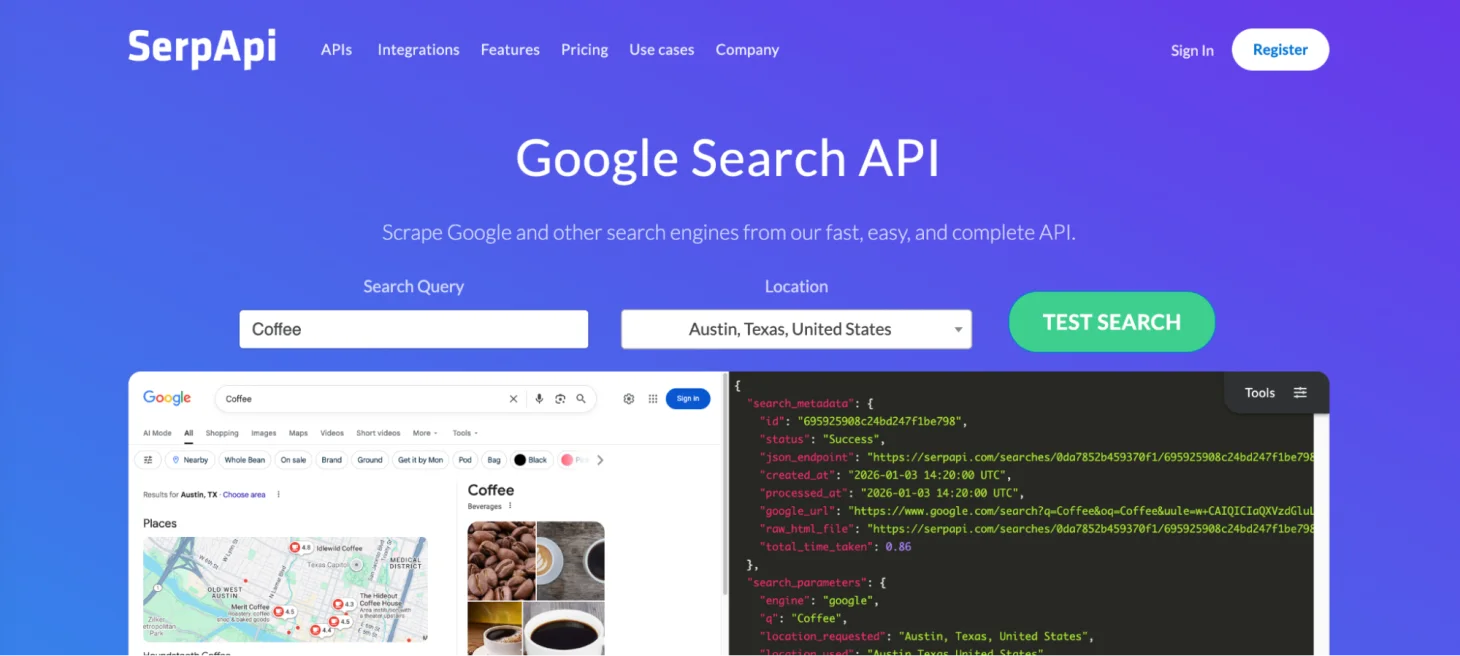
SerpApi retrieves search result pages live and delivers them as JSON, for Google and many other search engines. There are no keyword metrics and no backlinks.
There are monthly plans with a fixed allowance of searches and a free plan with 250 searches per month. Only successful searches are billed, and responses from the cache cost nothing.
Limits
20% of the monthly allowance per hour at most
Larger Cloud plans up to 54 million searches per month lower the price per search further
Responses stay in the cache for one hour and then cost nothing
Starter package: pay per use, minimum top-up $50.0050,000 credits for $50, valid for six months. Larger packages lower the price per 1,000 credits to $0.75 (500,000 credits for $375), $0.50 (2.5 million for $1,250) and $0.30 (12.5 million for $3,750).
How to read the comparison
The price applies to the selected query in the cheapest documented mode. With prepaid balances, you pay exactly this amount per query.
For plans with a fixed allowance, the price without an amount is the calculated price at full use of the allowance. If you enter an amount, the comparison divides the whole monthly price by your amount.
US dollar prices are converted with the ECB euro reference rate of November 20, 2026 for ordering (€1 = $1.0990). All prices as stated by the provider, plus sales tax where applicable. Promotional discounts are not included.
Providers where a plan with a price on request comes on top, and queries whose costs the provider does not document clearly, are not sorted by price. They appear in separate groups.
Features of the SEO APIs compared
Feature
DataForSEO
SE Ranking
Mangools
Ahrefs
Semrush
SISTRIX
Serpstat
Moz
SerpApi
Serper
SearchApi
Keyword data
yes
yes
yes
yes
yes
yes
yes
yes
no
no
no
Search results (SERP)
yesup to the top 200
yesGoogle only, as a job in a queue
yes
yesSERP Overview up to the top 100
yesmonthly snapshot from the database, not live
yesGoogle only, weekly snapshot
yeslive, Google only
yesbeta, top 10 only
yeslive
yeslive, Google only
yeslive
Backlink data
yes
yes
yesLinkMiner
yes
yes
yes
yes
yes
no
no
no
Site audit
yesOnPage API, $0.00015 per crawled page
yes
no
yes
yesProjects API
yesthrough on-page projects with their own crawl allowance
yes
no
no
no
no
Rank tracking
nono product of its own, only through repeated SERP queries
yesthrough the Project API, not in the Standalone package
yesSERPWatcher, daily only in the Agency plan
yesread-only, weekly updates, costs no units
yesPosition Tracking API
yes
yesreading the projects costs no credits
no
noonly through repeated searches
noonly through repeated searches
noonly as a SERP query with up to a hundred results
AI visibility
yesAI Optimization API
yesAI Search API
yesAI Search Watcher
yesBrand Radar
noEnterprise API only
yesstored answers from ChatGPT, Gemini and DeepSeek
yesown credits for observing AI answers
noMoz AI Explorer is a separate product
yesGoogle AI Overview and AI Mode
n/anot documented
yesGoogle AI Mode, ChatGPT, Gemini and Perplexity as queries of their own
Local data (Maps)
yesGoogle Maps and Local Finder
yesLocal Marketing API
n/anot documentedlocations down to city level, no Maps data documented
n/anot documented
yesLocal API with Map Rank Tracker
no
no
noonly through Moz Local with its own subscription
yesGoogle Maps and Local
yesGoogle Maps and Places
yesGoogle Maps
Other search engines
yesBing, Yahoo, YouTube, Baidu, Naver, Seznam
noSERP queries for Google only, rank tracking also for Bing, Yahoo and YouTube
noGoogle only
n/anot documented
noPosition Tracking only: Bing and Baidu
no
noonly a Bing database for the US
n/anot documentedBing and Yahoo are named for the keyword metrics
yesBing, Yahoo, Yandex, Baidu, DuckDuckGo and more
no
yesBing and more
Official MCP server
yesfree, you only pay for the data
yesover 180 tools, uses the credits of your plan
yesbeta, around 35 tools
yesfrom Lite, uses the same API units
yesuses the same API units
yescurrently uses no credits
yes
yesbeta, in paid plans
yes
n/anot documented
yes
Usable without a subscription
yes
yesbalance from €45
noonly with a plan
noonly with a plan from Lite
noplan plus monthly unit package
no
noonly the two prepaid products from $300
no
nomonthly plan
yes
nomonthly plan
Free trial
yes$1 trial balance and a free sandbox
yes14 days with 100,000 credits
yesfree plan with 5 keyword and 5 SERP lookups per day
nofree test queries only with a paid plan and only on sample targets
no
yes14 days of trial access
yestrial period without payment, scope not stated
yes50 rows per month free permanently
yes250 searches per month free permanently
yes2,500 queries for free
yes100 queries for free
A check mark appears only where the provider documents the feature for its API. The table scrolls sideways.
Links marked with * are affiliate links. If you buy something through one of these links, we earn a commission.
What does an SEO API actually cost?
The question sounds simple. Still, no pricing page gives you an answer you can compare. DataForSEO bills in dollars per task, SE Ranking in credits, Ahrefs and Semrush in units and Mangools in lookups per day.
That is why I calculated what 16 typical queries cost for 11 SEO APIs, for example the search volume for 1,000 keywords, a Google search result page or 1,000 backlinks.
In the comparison above, you pick the query and enter how many of them you need per month. Here in the article, I explain how the prices come about and which API I would use for what.
What is an SEO API and when do you need one?
An SEO API is basically an interface that lets you access SEO data programmatically. Instead of clicking through a dashboard, you send a request and get the data back directly.
What is it good for?
Automatic reporting for clients or stakeholders
Keyword research and clustering at scale
Competitor analysis without collecting data manually
Building your own SEO tools and dashboards
Feeding AI agents with real SEO data
Monitoring rankings automatically and setting up alerts
SEOs have used APIs for a long time. Marketers and content specialists work with them just as much today, because every provider in this comparison now has an MCP server. That lets you query the data straight from Claude, ChatGPT or Gemini without writing a single line of code.
How I compare the prices
Credits, units and lookups cannot be compared directly. One credit at SE Ranking buys something different than one unit at Ahrefs.
That is why I convert every API to the same 16 queries:
Search volume for keywords: Monthly Google search volume for a list of your own keywords in Germany.
Keyword difficulty for keywords: Difficulty score for a list of your own keywords.
Keyword ideas with search volume: Related keywords for a seed keyword, each with search volume.
Google autocomplete suggestions: The search suggestions Google shows while you type a seed keyword.
Google search results, top 10: The first ten organic Google results for a keyword.
Google search results, top 100: The first hundred organic Google results for a keyword.
Google search results with AI Overview: A Google search result page including the text and sources of the AI overview, if Google shows one.
Google Maps results: The local results from Google Maps for a search term, first results page.
Bing search results, top 10: The first ten organic Bing results for a keyword.
Backlinks of a domain: Individual backlinks with source URL, target URL and anchor text.
Ranking keywords of a domain: Keywords a third-party domain ranks for on Google, with position and search volume.
Domain overview: Key figures of a domain: organic traffic, number of keywords, referring domains and an authority score.
Referring domains of a domain: Domains that link to a domain, one row per referring domain.
Top pages of a domain: The pages of a third-party domain with the most organic traffic or the most rankings.
Organic competitors of a domain: Domains that rank on Google for the same keywords as a domain.
Site audit via API: Technical crawl of a website through the API, without JavaScript rendering.
For each query, I looked up in the provider's documentation which endpoint delivers it and how it is billed. That gives the price per 1,000 units.
There are two kinds of providers.
DataForSEO, SE Ranking and Serper sell prepaid balances. You pay exactly what a query costs, and the price per query stays the same whether you need 100 or 100,000 of them.
Ahrefs, Mangools, Semrush, Serpstat, Moz, SerpApi and SearchApi sell a fixed allowance per month, SISTRIX one per week. The price per query there depends on how much of that allowance you actually use. Without an amount, the comparison shows the calculated best price at full use of the allowance. As soon as you enter an amount, it divides the whole monthly price of the smallest plan that fits by your amount.
Note
With Ahrefs, Mangools, SISTRIX and Serpstat, the API is part of the regular plan. The monthly price also pays for the complete web interface there. If you use the tool anyway, the API costs you nothing extra.
The comparison converts US dollar prices with the euro reference rate of the European Central Bank for ordering. Promotional discounts are not included.
Which SEO API is the cheapest?
The table shows the lowest price per 1,000 units for four common queries. You can find all 16 queries in the comparison above. For providers with a monthly allowance, the price applies to a fully used allowance in the plan with the lowest price per unit. That is almost always the largest and most expensive plan.
API
Search volume
SERP top 10
SERP top 100
Backlinks
DataForSEO
$0.06
$0.60
$6.00
$0.06
SE Ranking
€0.018
€1.80
€1.80
€0.18
Mangools
unclear
€5.43
€27.14
€0.081
Ahrefs
€1.92
€8.73
€52.35
€0.698
Semrush (plus plan)
$1.30
$6.50
$65.00
$2.93
SISTRIX
unclear
€24.98
€249.75
€2.50
Serpstat
$0.25
$1.25
$12.48
$0.25
Moz
$1.00
$21.00
no
$1.00
SerpApi
no
$3.75
$37.50
no
Serper
no
$1.00
unclear
no
SearchApi
no
$1.00
unclear
no
Source: pricing pages and API documentation of the providers, checked on November 23, 2026. Prices as stated by the provider, plus sales tax where applicable. ECB euro reference rate of November 20, 2026: €1 = $1.0990. “Unclear” means the provider does not document the costs clearly. For Semrush, a plan with a price on request comes on top. For Serper, the price of the smallest package is shown.
Four things stand out.
DataForSEO leads on search results.
A Google search result page with ten results costs $0.0006 there in the standard queue, so $0.60 for 1,000. If you need the top 100, the picture changes. DataForSEO charges extra for every further page, while SE Ranking always returns up to a hundred results for 10 credits. That makes 1,000 top-100 queries cost €1.80 at SE Ranking and $6 at DataForSEO.
For keyword data, it depends on the query.
You get search volume for your own keywords cheapest at SE Ranking. A request with up to 5,000 keywords costs 100 credits and returns CPC and keyword difficulty along with it. With the smallest balance, that is €0.018. DataForSEO charges $0.06 for a task with up to 1,000 keywords.
For keyword ideas it is the other way round. SE Ranking charges 10 credits per keyword returned, so €1.80 for 1,000 ideas. DataForSEO delivers the same amount for around $0.13.
Ahrefs and Semrush are much more expensive per query.
Ahrefs alone charges 10 units per keyword for search volume. Even in the Advanced plan, that comes to around €1.90 for 1,000 keywords. Semrush is in a similar range at 20 units per keyword. In the table, only the price of the unit package is shown for Semrush, because the plan with API access is only available on request.
Mangools is in the middle field for search results and backlinks. That said, you pay the full plan every month, and once the daily allowance is used up, that's it. So the price from the table only applies if you use up the allowance.
The new providers shift the picture only a little.
Serpstat bills almost everything at one credit per result row. In the Agency plan that is $0.25 for 1,000 keywords or backlinks, in the Team plan $0.65. That puts Serpstat between DataForSEO and Ahrefs for row data. At Moz, a row in the largest plan costs 0.1 cents, so $1 for 1,000.
SISTRIX is expensive per query. Even in the Premium package, 1,000 keyword rows cost around €2.50, because the credits per week are tight. The API there is an extra on top of the Toolbox and not a product for mass queries.
The pure SERP providers Serper and SearchApi cost around $1 per 1,000 search result pages, which is above DataForSEO and below SerpApi. Serper reaches this price in the smallest package already, SearchApi only in the largest plan.
The SEO APIs in detail
1. SE Ranking API + MCP
SE Ranking is known to most people as an SEO platform. It offers tools for keywords, rank tracking, backlinks, site audits, competitor analysis, local SEO and more. On top of that comes an API of its own, which is based on the same data as the platform itself.
What you can retrieve through the SEO API:
Keyword data from a database with around 5.5 billion keywords in 188 countries
Backlink data including anchor texts and referring domains
Google search results for any keywords
Results from site audits
Rank tracking data at domain or page level
AI Search Visibility (how often and where your domain appears in AI results)
It's convenient to get keyword data, backlinks and rankings through a single interface instead of connecting three different APIs. The API plugs straight into n8n, Make or Looker Studio. Or into your own tools, depending on where your workflow runs.
You have a choice on price. You can top up a balance that doesn't expire. 250,000 credits cost €45. If you need more, you book an annual package from 12 million credits. And the Core and Growth plans already include a small allowance of API credits. In the 14-day trial you get 100,000 credits for free.
I checked the billing on my own account. A request with 2,000 keywords cost exactly 100 credits, a search result page 10 credits per keyword.
SE Ranking also has an MCP server of its own.
What is this MCP anyway?
MCP stands for Model Context Protocol, an open protocol that lets AI assistants such as Claude, ChatGPT or Gemini access external tools and data sources directly. Put more simply, you can query data from SE Ranking directly in your AI assistant.
SE Ranking's MCP server has over 180 tools. That sounds abstract at first, so let me get concrete.
What that means in practice
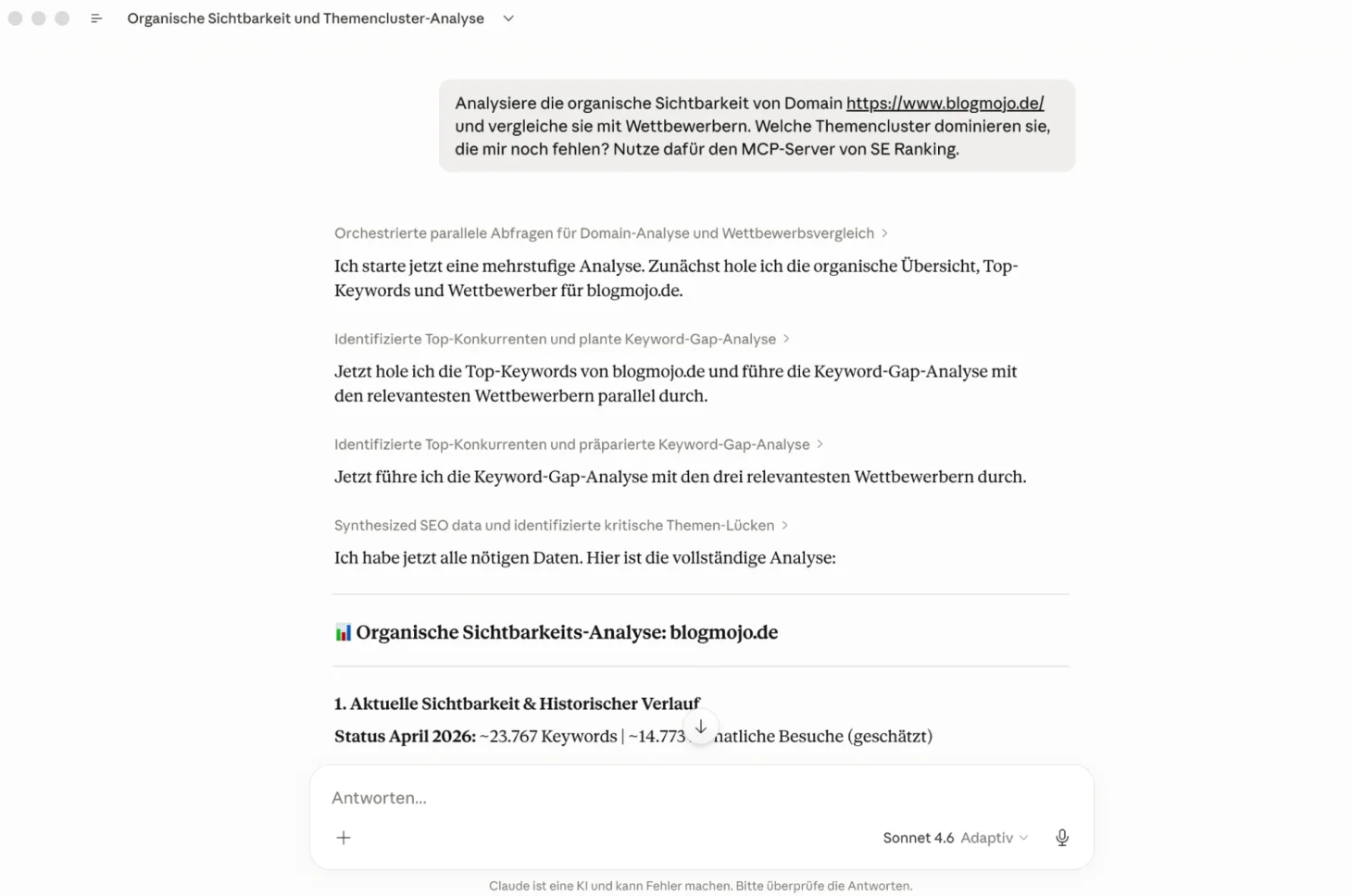
Take competitor analysis. Normally you have to enter a domain, look up metrics manually, merge numbers somewhere, and only then start interpreting. With the MCP server, I write a prompt in Claude instead, for example: “Analyze the organic visibility of domain X and compare it with competitors Y and Z. Which topic clusters do they dominate that I'm still missing? Use the SE Ranking MCP server for this.” Claude pulls the current data straight from SE Ranking through the MCP server and delivers the analysis to me.
After that I can go straight on to ask about specific content gaps, keyword priorities or a first draft of a briefing.
Of course, that doesn't replace strategic judgment. The priorities and the final assessment stay with you. But marketers, agencies and product teams get what amounts to a personal SEO assistant that knows their data and delivers a data-based answer to every question right away.
2. DataForSEO
If you have a developer team and know exactly which data you need and in what volume, DataForSEO is probably the most technically flexible option on this list.
What DataForSEO delivers:
Search results for Google, Bing, Yahoo, YouTube, Baidu and other search engines
Keyword data with search volume, CPC and competition from Google Ads
Backlink data
On-page crawls and technical audits
Local SEO data from Google Maps
Data on visibility in AI answers
The pricing model is the simplest in the whole comparison. There is no subscription. You top up at least $50 and pay per API call. The balance doesn't expire, and new accounts get $1 for testing.
Watch the mode. In the standard queue, a search result page costs $0.0006, in live mode with an instant response $0.002. For reports that run overnight, the queue is perfectly enough.
DataForSEO assumes a bit of technical know-how. There is a sandbox to try things out and a free MCP server, but at its core you get raw data, and what you do with it is up to you.
That's why I'd recommend DataForSEO for teams that build their own SEO tools, dashboards or products. Or as a data backend for agencies that process SERP data at scale.
3. Mangools API
Mangools is best known for KWFinder. Meanwhile, SERPChecker, SERPWatcher, LinkMiner and SiteProfiler can also be addressed through the API and the MCP server.
The API costs nothing extra. It's part of every plan, including the free one. In the Basic plan you get 100 keyword and 100 SERP lookups per 24 hours, in Premium 500 and in Agency 1,200.
That cuts both ways.
For small, regular evaluations it fits well. From €37.70 per month with annual billing, you get keyword data, search results, backlinks and rank tracking in one package.
It's no good for large volumes. Once the daily allowance is used up, your requests pause until the next day, and you can't buy more. On top of that, there is a speed limit of three requests in 30 seconds.
Note
One API request uses 2 lookups. That is what the Mangools comparison page says, and it is what was deducted from a Premium account on November 23, 2026, both for related keywords and for a search result page. The technical API description still says 1 lookup.
There is no site audit through the API, and the domain overview returns authority and backlink metrics, but no organic traffic.
4. Ahrefs API
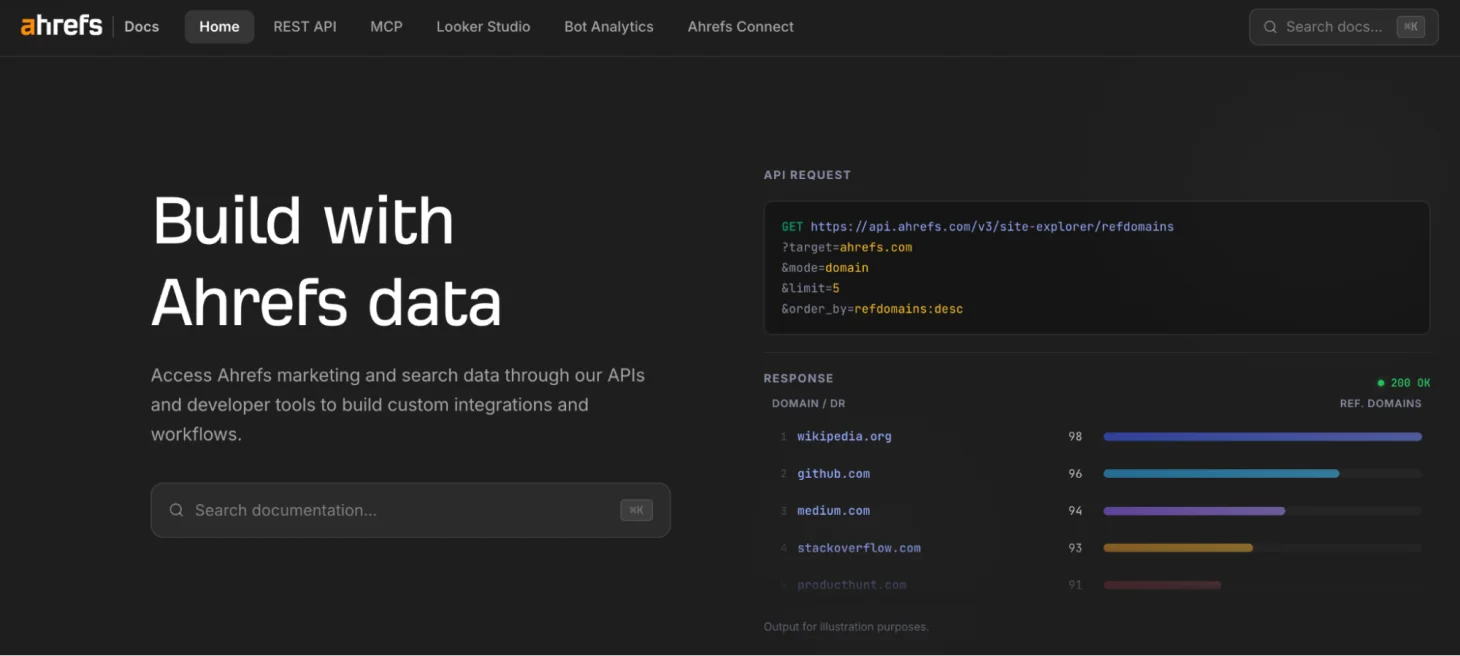
Ahrefs is known in the SEO world mainly for its backlink index. The Ahrefs API v3 gives you access to exactly this index and beyond that to Site Explorer, Keywords Explorer, SERP Overview, Rank Tracker, Site Audit and Brand Radar.
Ahrefs now has an MCP server too. It is available from the Lite plan and uses the same units as the API.
The API is included in the Lite, Standard and Advanced plans. That sounds good at first.
That said:
On the cheaper plans, access is heavily limited. Lite comes with 200,000 units per month and returns 100 rows per query at most, Standard 250 and Advanced 500. The documentation of the endpoints does not provide for paging through longer lists.
You can only buy more units in the Enterprise plan. If the monthly allowance in Lite, Standard or Advanced is used up, you have to wait for the next billing date.
Then there is the billing model. Every query costs at least 50 units, and expensive fields such as search volume or keyword difficulty cost 10 units per row. The 200,000 units in Lite are enough for around 18,000 keywords with search volume that way.
I see Ahrefs as an option for teams for whom backlinks are really the core KPI and who pay for Ahrefs anyway. For everything else, there are cheaper alternatives on this list.
5. Semrush API
Semrush also offers an API of its own. You get access to keyword data, backlinks, domain analyses, Position Tracking and Site Audit.
The biggest problem with Semrush is the pricing model.
You need two things. First, a plan with API access. On the pricing page, that's only the Advanced plan, and its price is available on request only. Second, a monthly package of API units. The smallest holds 1 million units and costs $100 per month, the largest 20 million units for $1,300.
What you don't use expires at the next billing date.
Per query, Semrush is no bargain either. Search volume and keyword difficulty cost 20 units per keyword, every backlink row 45 units. For search results, Semrush also doesn't deliver a freshly retrieved state, but the stored monthly state from its own database.
The Traffic & Market API with traffic and market data is a product of its own that you have to book through sales on top.
Semrush now has an MCP server as well. You can connect Claude, ChatGPT or Cursor directly and query data. The server uses the same units as the API.
For agencies that already work deep in Semrush, this can fit. You can't just get started here.
6. SerpApi
SerpApi is not a full SEO data provider like the others. It gives you structured access to search result pages, and not only on Google but also on Bing, DuckDuckGo, YouTube, Google Maps, Google Shopping and more.
That helps if you know you need SERP data regularly at scale and don't want to build your own scraping infrastructure. SerpApi takes care of the technical side (proxies, anti-blocking measures, clean JSON output) and you get the data.
What you can do with it:
Track SERP features (featured snippets, People Also Ask, local pack)
Monitor ranking positions for specific search queries
Read out Google AI Overviews and the AI Mode
Price tracking for Google Shopping
There are no keyword metrics, backlinks or technical audits here.
Price-wise, SerpApi is well above DataForSEO. The entry plan costs $25 per month for 1,000 searches, so 2.5 cents per search. 250 searches per month are free permanently. Because Google only returns ten results per page now, you need ten searches for the top 100.
SerpApi fits developers and teams that build SERP monitoring tools, content apps or AI agents and need clean search results from several search engines.
7. SISTRIX API
SISTRIX is known in the German-speaking region mainly for its visibility index. The API accesses the same data as the Toolbox, that is, rankings, keywords, links, on-page projects and stored AI answers.
Billing runs through credits per week that you share with the exports from the Toolbox. The Start package for €149 per month includes 1,000 credits per week, Plus for €299 includes 10,000 and Premium for €999 includes 100,000. Unused credits expire every Monday.
Most queries cost 1 credit per result row. A domain overview costs 5 credits, the link overview 25. The top 100 for a keyword cost 100 credits, so in the Start package the weekly allowance would be used up after ten keywords.
Note
At SISTRIX, rankings and search results are a weekly snapshot. The keyword queries return a field “traffic”, which SISTRIX calls search volume in only one place in the documentation and defines nowhere. In the comparison, search volume therefore appears without a price.
The SISTRIX API fits if you pay for the Toolbox anyway and want to pull the visibility index or individual metrics into your own reports. It is not meant for large volumes of data.
8. Serpstat API
Serpstat covers almost everything the web interface can do through its API, including keyword and domain analyses, backlinks, live search results, site audits and rank tracking.
The API is part of the Team ($129 per month, 200,000 credits), Team x2 ($209, 400,000 credits) and Agency ($499, 2 million credits) plans. The Individual plan has no API access. Almost every query costs 1 credit per result row. Exceptions are the domain overview at 5 credits per domain and the live search result page at 5 credits, with AI Overview 10.
For large volumes of search results and search volume, Serpstat sells two separate prepaid products. Both require at least $300 in advance and are therefore only noted as a hint in the comparison.
Serpstat fits if you want a complete SEO tool including API at a fixed monthly price and can get by with one request per second.
9. Moz API
The Moz API is a subscription of its own, independent of Moz Pro. It is known for its link data with Domain Authority and Spam Score. On top of that come keyword metrics, keyword suggestions and ranking keywords.
Billing is in rows. Plans range from $20 per month for 3,000 rows to $500 for 500,000 rows, and 50 rows per month are free permanently. One keyword, one backlink or one domain costs one row each. Search results are expensive. A freshly generated search result page costs up to 21 rows and only returns the top 10.
The Moz API fits if you need Domain Authority or Spam Score for many domains, for example to evaluate link sources. For rankings and search results there are cheaper providers.
10. Serper
Serper delivers Google search results only, including web search, images, news, Maps, Places, shopping and autocomplete. There are no keyword metrics and no backlinks.
There is no subscription. You buy credit packages that are valid for six months. The smallest package costs $50 for 50,000 credits, so $1 per 1,000 search result pages. In the largest package (12.5 million credits for $3,750), the price drops to $0.30. A Maps query costs 3 credits. New accounts get 2,500 queries for free.
Note
The Serper documentation could not be reached during my check. The counting comes from the pricing page and the public test playground. What a hundred results per keyword cost could not be verified that way and appears in the comparison without a price.
Serper fits if you only need live Google search results and don't want to take out a monthly subscription.
11. SearchApi
SearchApi works like SerpApi. You retrieve search result pages live and get them as JSON, for Google, Bing and around a hundred other sources, including Google Maps, autocomplete, the AI Mode and ChatGPT.
Monthly plans start at $40 for 10,000 searches, so $4 per 1,000. In the largest listed plan (5 million searches for $5,000), the price drops to $1. For testing there are 100 queries for free. Per hour, you may use one fifth of the monthly allowance at most.
SearchApi fits the same cases as SerpApi and is usually cheaper at the same volume. In the entry plan, you get ten times as many searches for $40 as with SerpApi for $25.
The free addition: Google Search Console API
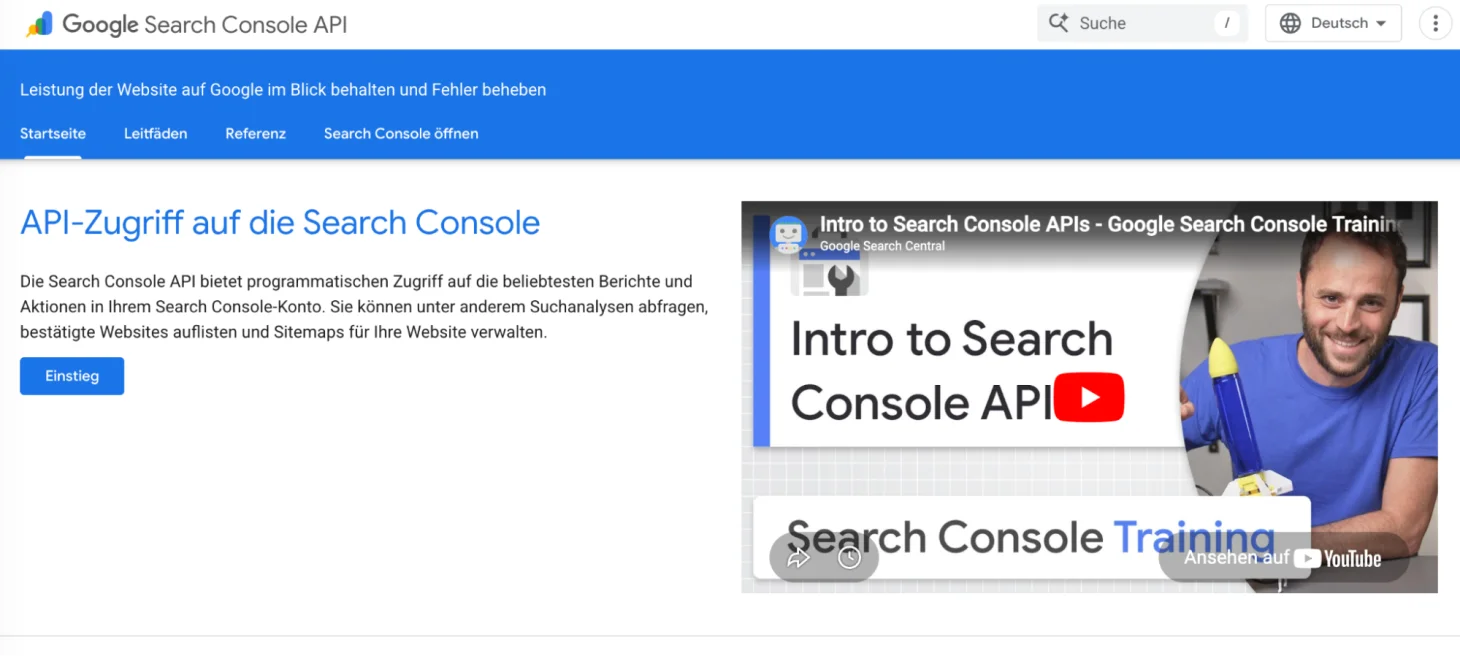
The Google Search Console API is missing from the price comparison because it costs nothing. It gives you access to exactly what you also see in the dashboard, that is, impressions, clicks, CTR and average position for all pages and keywords of your own properties.
Yes, the GSC API only delivers data for websites you have verified yourself. Competitor analysis, backlinks, keyword opportunities for other people's domains, that doesn't work here.
Why use the API at all if you can see all of this in the dashboard? Because of automation. You can generate performance reports for your own or client properties automatically, monitor the indexing status and let the data flow straight into Looker Studio, Google Sheets or your own dashboards. One query returns up to 25,000 rows.
As a complementary data source alongside one of the other APIs on this list, it's practically indispensable. As the only SEO API, it is naturally too limited.
Which SEO API would I pick?
That depends on what you plan to do.
You want to use SEO data in an AI assistant: SE Ranking. The MCP server covers keywords, backlinks, audits and AI visibility, and with a balance from €45 you take no subscription risk.
You're building your own tool or processing large volumes: DataForSEO. No subscription, the lowest prices for search results and the broadest choice of data.
You only need small volumes and like fixed costs: Mangools. The API is part of the plan you pay for KWFinder anyway.
You only need Google search results: DataForSEO if the results may come from the queue. Serper if you want a balance without a subscription and an instant response. SerpApi or SearchApi if you query many different search engines.
You already work with Ahrefs, Semrush, SISTRIX or Serpstat: Use their API for what only they deliver, and get bulk data cheaper elsewhere.
I'd add the Google Search Console API in any case. It costs nothing and delivers the only real Google data for your own website.
FAQ
Here you'll find answers to common questions about SEO APIs:
What is an SEO API?
An interface that lets you pull SEO data programmatically, without opening a dashboard. You send a request, get structured data back, and can process it right away, for example in reports, dashboards, your own tools, or AI workflows.
Which SEO API suits someone without a technical background?
The Google Search Console API is a free starting point for your own data. If you also need data on competitors and keyword research, take a look at SE Ranking. That's especially true because the MCP integration lets you get started through AI assistants without writing a single API request.
How much does an SEO API cost?
That varies a lot. The Google Search Console API is free. DataForSEO and SE Ranking sell balances that you use up per query, with DataForSEO from a $50 top-up. With Ahrefs, Mangools, SISTRIX and Serpstat, the API comes with a fixed allowance in the regular plan. Semrush requires a plan with API access plus a monthly package of API units. What a specific query costs at each provider is shown by the comparison above.
What is MCP and why does it matter for SEO?
MCP stands for Model Context Protocol, a standard that lets AI assistants access external tools and data sources. Ten of the eleven providers in the comparison now have an MCP server of their own, including DataForSEO and Mangools. That way, Claude or ChatGPT can access SEO data directly, analyze it, and deliver a usable result, without you having to export or paste data manually.
Can I combine several SEO APIs?
Yes, and many professional teams do exactly that. A typical combination: one SEO API for keyword and competitor data plus the Google Search Console API for your own performance data.
Do I need technical skills to use an SEO API?
Traditionally, yes. The MCP integration lowers the barrier to entry considerably, though. With an MCP server, you can access and work with SEO data through Claude or ChatGPT without writing a single API request yourself.
Finn Hillebrandt is the founder of Blogmojo and an SEO expert with 15+ years of experience.
He has been an online entrepreneur since 2011 and started Blogmojo in 2016. It has grown into one of the most-visited German blogs about SEO, WordPress, and blogging, with more than 1,000,000 visitors a year.
Finn has written 140+ articles on blogging, WordPress, and SEO. The articles on blogmojo.com are English translations of them.