When I tell someone that I'm a full-time blogger, in 90% of cases I get the question: “So you can actually make money with that?”
I'll admit that this question still surprises me (at least at first).
Because by now it's a given for me that it's possible:
Being a “blogger” or “influencer” has developed over the last decade from a hobby into a serious profession and business model.
It's no coincidence that more and more bloggers earn a side income with their blog or can even live entirely off it.
In this article I show you 14 ways to make money blogging. With tips, examples and their pros and cons:
- From Google AdSense and affiliate marketing to your own products, there are plenty of legitimate ways to earn an income with your blog.
- Every method has its pros and cons: some require a high reach, others already work with a smaller but loyal community.
- Your own digital products such as online courses or member areas are usually the most profitable. They scale well and you're independent of partners.
1. Google AdSense

One of the easiest ways to make money with your blog is Google AdSense.
It works like this:
You embed a code snippet in your blog (e.g. in a sidebar widget). An ad is then displayed at that spot. When a visitor clicks one of the ads, you get paid (usually between €0.10 and €0.80 per click, in some cases more).
Google offers over a dozen different ad sizes (including ads that adapt to the screen size), so there should be a fitting size for every blog.
We ourselves currently only earn a few hundred euros with it. But I know a few bloggers who earn four-figure amounts a month with it. For that, though, you usually need a very high number of page views (at least 200,000, if not more) and a large number of ads on the blog.
I show you how to get started at no extra cost in my article: Create a free website: The 7 best providers in 2026.
- Easy to integrate
- Responsive ads for mobile devices
- Ads adapt automatically to your readers' interests
- Earnings are paid out monthly
- Extensive statistics for optimizing user interaction
- You usually need high visitor numbers for it to bring in anything
- Slows down loading times
- Often blocked by ad blockers and increasingly ignored by readers
- Has to be mentioned in your privacy policy and requires a cookie notice
2. Selling banner ads directly
As an alternative to Google AdSense, you can also sell banner ad spots on your blog yourself (known as “direct marketing”). If you've found a fixed advertising partner, this can pay better than Google AdSense or other display networks.
Billing can work in different ways, e.g. per click, per view, or for a fixed monthly or yearly amount.
- Higher earnings than with Google AdSense are sometimes possible
- Usually not detected by ad blockers
- Doesn't have to be mentioned in your privacy policy and doesn't require a cookie notice
- Only a small impact on loading times (for image-only ads)
- You have to find a suitable advertising partner yourself
- Not as well tailored to your visitors' interests
- Visitors increasingly ignore classic banner ads
3. Ad marketers
If you don't want to take care of marketing your banner spots yourself, you can also hire an ad marketer who looks for suitable clients for you.
Of course the marketer wants a piece of the pie for that, but it can still be worth it for you. First, the marketer usually has a lot of experience in acquiring clients and negotiating prices, plus an existing client base.
Besides banner spots, many marketers also arrange sponsored posts, so they can take work off your hands in that area too.
- Higher earnings than with Google AdSense or direct marketing are sometimes possible
- They often arrange sponsored posts as well
- You have more time for your blog
- The marketer wants a piece of the pie
- Contracts are often exclusive, which means you're completely tied to the marketer and the clients they bring in as far as advertising goes
4. Affiliate programs
Affiliate programs are another good way to make money with your own blog.
The principle is simple: you embed an affiliate link in your blog. When a visitor clicks that link and orders something on the linked website (e.g. at an online store) or signs up for something (e.g. a newsletter or a prize draw), you get a commission for that order or signup.
The size of the commission depends on the product category. For electronics you often only get between 1 and 4% commission, because the margins there are quite low.
For digital products such as software, ebooks or similar, you can get 30% to 60% commission. Affiliate programs in the finance sector also pay high commissions.
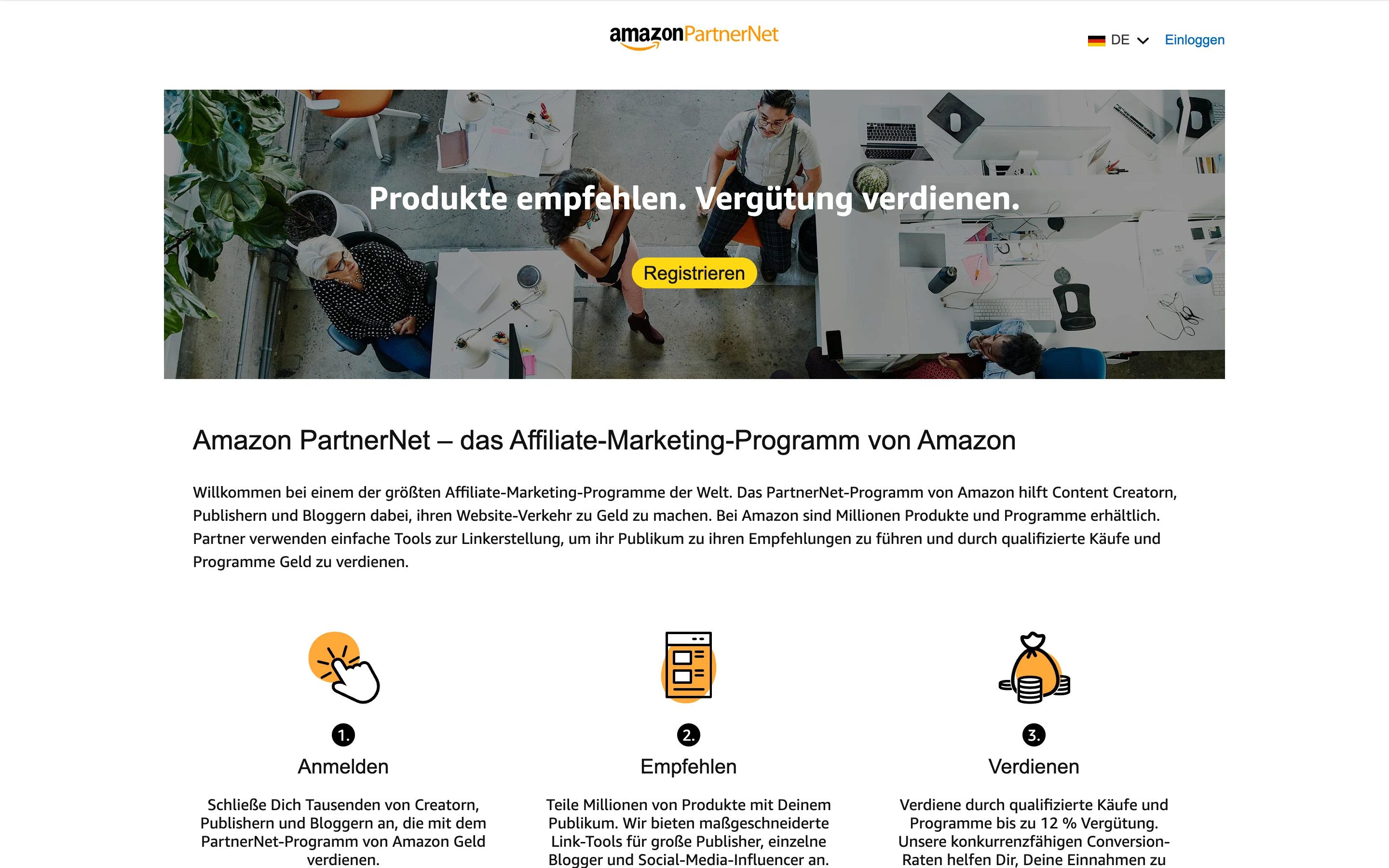
The most popular and best-known affiliate program among bloggers and website owners is probably the Amazon affiliate program.
It's also a good fit for beginners, because adding affiliate links to your own blog is quick and easy. Amazon also offers products from pretty much every area. Unfortunately, the commissions are comparatively low and the cookie duration of one day isn't particularly long.
If you're interested in higher commissions and want to promote retailers other than Amazon on your blog, the easiest way is to sign up with an affiliate network. Affiliate networks bring together hundreds or even thousands of affiliate programs from online stores and service providers under one roof.
The largest and best-known affiliate networks include AWIN, belboon, Superclix , ADCELL, financeAds, CJ Affiliate, Webgains or Digistore24.
Many online stores and providers also have in-house affiliate programs. Commissions there are usually a bit higher, because there's no affiliate network in between that takes a share for the technical side. The partnership itself is also usually closer and more personal, and you can often negotiate commissions.
- Can be worked into the website unobtrusively and don't disturb the reading flow
- Sometimes allow significantly higher earnings than Google AdSense
- You can profit from product sales without any work for shipping or manufacturing
- Tracking of sales, payouts and invoicing usually run automatically
- There are many affiliate programs and networks, which allows you to diversify your sources of income
- Have to be labeled as advertising
- Often require an application (not every website is accepted into every affiliate program)
- Referred sales sometimes have a long processing time (a sale may not be paid out until after 3 months)
- Affiliate programs may change their commissions, be paused or shut down entirely (so you shouldn't rely on just one affiliate program)
- Mainly suited to Google or Pinterest traffic (when visitors already want to buy)
5. Sponsored posts
Sponsored posts (often just called “collaborations”) are blog articles, social media posts or a combination of both that a company pays you to publish. They present or show the company's products or services.
That can be, e.g., a review or test report, a prize draw, a casual mention or recommendation of a product, or a report from an event.
How much you can earn with a sponsored post depends, e.g., on your blog's visitor numbers, your follower numbers and the interaction on your social media channels, or how well you fit the brand.
I know a few bloggers who get over €3,000 for a sponsored blog article. There's hardly an upper limit.
- Fairly easy money
- Depending on your blog's name recognition, reach and target group, high pay for sponsored posts is possible
- Longer-term collaborations are possible, e.g. as a brand ambassador
- Usually only a one-time payment per post
- Income is unpredictable and irregular
- Sponsored posts have to be clearly labeled as such, or you risk a cease-and-desist letter (Abmahnung)
- The post and/or the advertised company may not be a perfect fit for your own blog
- You can't publish too many sponsored posts per month, or you might drive away your own readers
- Google may penalize you if links aren't marked with the sponsored attribute
6. Selling your own products
Selling your own products on your blog is the pinnacle!
Developing, manufacturing and selling your own products can take a lot of work and sometimes high investment costs. But it also lets you make more money with your blog than with all the other methods mentioned here. You should weigh up whether it might even make sense to create an online store.
After all, you don't have to share your profit with anyone. You get the whole pie, not just a part of it.
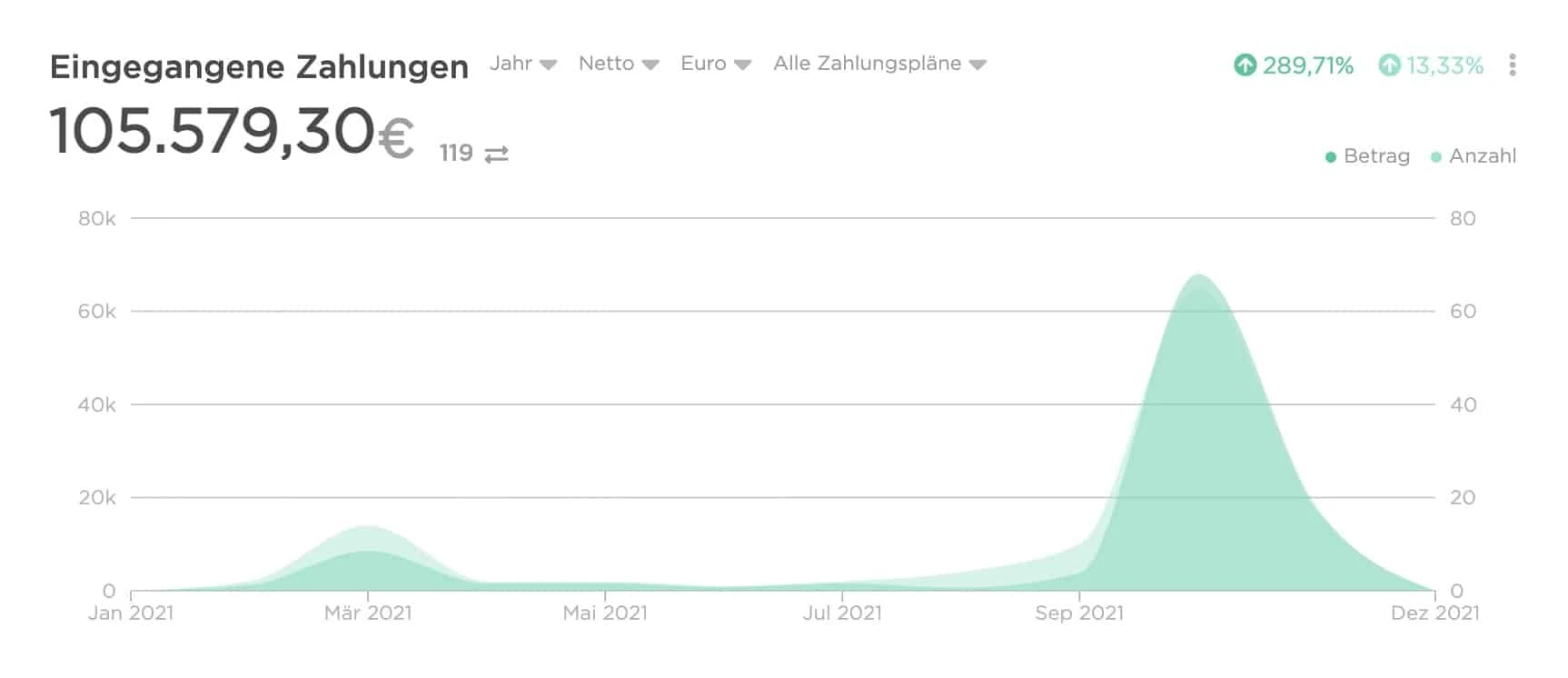
A very good example is our SEO course, with which we earned over €100,000 in 2021 alone:
- Significantly higher earnings are possible than with other methods
- You're independent of advertising partners
- Your products let you meet your visitors' needs better
- Your products let you fulfill yourself
- You may have to deal with customer support
- Your risk of a cease-and-desist letter is higher and you have to watch out for more legal pitfalls
- Product development and manufacturing may require high investments and/or a lot of time
- You have to integrate an order system into your blog
- More work because of shipping goods (digital products are easier to automate)
- More administrative and bookkeeping work
7. Collecting donations
If you want to make money with a blog, you can also collect donations from your readers. As your only source of income, this often doesn't work, but it can serve to earn a few euros on the side.
In return for a donation, you can offer readers, for example, to read articles a few days earlier or to receive a small, exclusive newsletter.
To implement collecting donations technically on your blog, there are various options and systems besides Tipeee, e.g. embedding a PayPal donate button or the micro-donation service Flattr.
- An unobtrusive way to make money blogging
- Easy to integrate into your blog
- You need a large and above all very loyal fan base
- Readiness to donate depends on the reader and the topic
- May require you to reduce or completely do without other types of advertising
- Your readers may have to sign up with a donation service to be able to send donations
- Your readers may only be ready to donate once they get something in return (e.g. exclusive blog articles or an ebook)
8. Guest blogging
Bloggers are currently in high demand as guest authors or even as permanently employed editors for corporate blogs and for online or offline magazines.
Not only because editorial teams always need fresh content and are constantly on the lookout for new editors, but also because many bloggers bring their own fan base with them.
Bloggers are also seen as authentic and usually communicate with their readers on a more personal, friendly level (keyword: reader loyalty!), which many large editorial teams lack.
- You get the chance to promote your own blog
- You can use guest blogging as a reference to become a guest author for other blogs or online magazines
- You can often link to your own blog
- You aren't writing content for your own blog in the meantime
- You often have to hand over the rights to your post completely to the online magazine or corporate blog (including images) and can't use the content anywhere else
9. Hosting events
As a blogger, you can also make money by hosting events. For example, you can offer workshops for interested readers, which is especially popular with DIY and food bloggers.
Another option is to host events for other bloggers. Successful with this concept are, e.g., Clara and Ricarda, who organize workshops, barcamps and conferences for bloggers all over Germany with their event network BLOGST.
- Very good for networking, meeting new people and building your own brand
- A lot of organizational work (ticket sales, venues, catering, etc.)
- Sometimes involves high investments and therefore risk
- Conferences in particular are often only profitable with sponsors
10. Member area
A paid member area is the next level up, or the broader form, of the paywall.
Members don't just get to read exclusive blog articles, they can also access other exclusive content such as videos, ebooks, cheat sheets, tools or knowledge bases.
Memberships often also include access to private (mastermind) groups, coaching hours, webinars, workshops or an online course.
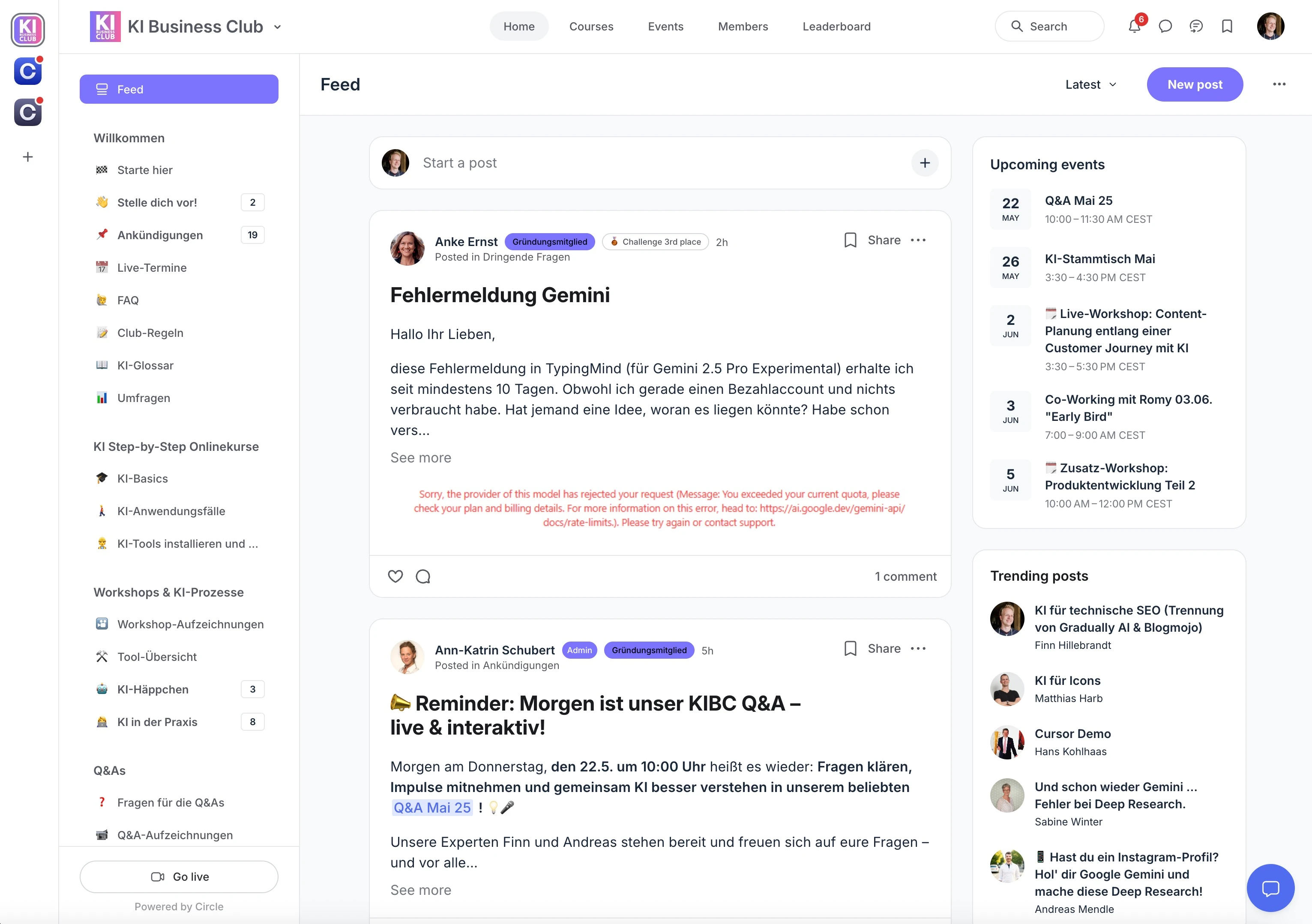
With our member area on the topic of AI, the KI Business Club, we make five-figure revenues every month.
- Income is very predictable
- You don't have to look for advertising partners
- You don't have to send your visitors to other websites to make money with your blog
- You turn visitors into fans and loyal customers
- Many design options
- Requires expert status and good positioning within a niche
- You are responsible for the technical integration of the member area
- A lot of work to create exclusive content
- Requires regular updates so customers don't cancel their subscription
11. Exclusive content platforms

A very good alternative to your own member area is “exclusive content platforms” such as Patreon or OnlyFans.
They have become more and more popular in recent years:
OnlyFans alone processed more than 6.6 billion US dollars in transactions from fans to creators in 2023.
And not without reason:
They make it easy to offer premium content on a subscription basis and to collect donations from your own fans.
You probably know them mainly from Instagram, TikTok or YouTube channels, but they work for blogs as well.
A downside compared to membership software like Circle or membership plugins is that you have to hand over a not insignificant part of your income to the platform.
On Patreon you pay 8 to 12% of the income you earn on Patreon (plus fees for payment processing, currency conversion and payout, as well as any taxes that apply). On OnlyFans it's even 20%.
- Income is very predictable
- You don't have to look for advertising partners
- You turn visitors into fans and loyal customers
- You don't have to set anything up technically (setting up a member area in WordPress can be very tedious and time-consuming)
- You have no work with payment processing, Patreon & Co. take care of that
- High fees (between 8 and 20% of your income)
- A lot of work to create exclusive content
- You're tied to the platform, and switching platforms is time-consuming
- Requires regular updates so customers don't cancel their subscription
- You have to chat with your members and answer comments
12. Coaching and consulting
If you're considered an expert in your niche as a blogger, you can also earn your living with coaching and consulting.
As with digital products, this works best in classic consulting niches such as online marketing, business and career, dating, fitness, finance, self-publishing or self-help.
If you can solve your readers' problems and they're willing to pay, it also works in other areas.
- High hourly rates are possible
- In many cases you can offer coaching and consulting from anywhere, e.g. via Skype, WhatsApp, email or phone
- Requires expert status and good positioning within a niche
13. Selling or renting links
Another source of income for bloggers is selling or renting links from their own blog. You can sell links not only from articles, but also from the sidebar, the homepage or the footer.
With rentals, payment is made monthly or yearly, with a sale it's a one-time payment (the link is then online on the blog for an agreed period or forever).
Why you can make money with link selling is obvious: companies, especially online stores, often have difficulty getting relevant backlinks (e.g. for individual products or category pages) and therefore don't rank as well on Google.
That's why link selling is an easy way for companies to push their own Google ranking.
- Very little work
- Regular monthly income
- Depending on the authority and popularity of your blog, high earnings are possible
- You can easily find customers for text links through online portals such as SeedingUp
- Google may penalize you for selling dofollow links
- SEO disadvantages with sitewide links (e.g. in the footer)
- Selling dofollow links is considered unprofessional
14. Selling your blog
Are you out of your mind? Making money by selling your own blog...
But yes, it can be an option. Especially if you've run out of steam and have actually wanted to start a new project for a while (the startup capital from selling the blog can come in very handy for that!)
However, I'd advise you not to think about it twice, but five times. First, your blog and with it your source of income is gone. And second, you may well not get the sum from the sale that you expect or that you need to start something new:
The problem with many blogs is that they're tied to one person and can therefore only be continued by someone else to a limited extent. Also, buyers are primarily interested in a blog's passive income (e.g. earnings from AdSense or affiliate marketing). Many blogs, however, earn almost exclusively active income (e.g. from sponsored posts).
- A lot of money at once that you can use to start a new project
- Your blog is gone (and with it your regular source of income)
- You may not get back what you invested in your blog or what you had in mind as a sale price
FAQ
Here I've put together the answers to the most common questions about making money blogging:
How much does a blogger earn?
I know bloggers who reached an income of €2,000 to €4,000 in a short time. Others earn over €5,000 or even over €10,000.
Of course, every blogger earns a different amount from each of these income types, so it's hard to say exactly how much a blogger earns.
How long does it take to make money with a blog?
There's no one-size-fits-all answer to that question.
It depends on many factors, such as your choice of niche, the time you invest, your previous experience, your personal motivation, whether you have a mentor or a mastermind group, and so on.
In 2011, I managed to make a living from blogging within 8 months and quit my job as a translator. Without a mentor and without any prior knowledge.
The conditions back then were easier, though.
Do people still read blogs?
It depends on how you approach blogging.
There are over 600 million active blogs worldwide, and blogging is still the third most common content strategy.
That said, you have to try a bit harder these days than you used to in the past to rank on page 1 of Google and get people to read your content.