
Shopify is, in my view, the most beginner-friendly shop system on the market, and it still comes with a large range of features.
I also appreciate that you can adapt Shopify very individually to your needs.
In our shop system comparison it comes out as one of the best tools for exactly that reason.
Still, there are projects where Shopify doesn’t have to be the first choice.
That’s why in this article I’ve collected twelve great Shopify alternatives for you and worked out their pros and cons.
- 12 Shopify alternatives for every need: from beginner-friendly website builders like Wix and Jimdo to powerful open-source solutions like WooCommerce and Adobe Commerce.
- For WordPress users, WooCommerce is the best choice. For large shops with many products, Adobe Commerce or WooCommerce are recommended. For blogging features, WordPress with WooCommerce is unbeatable.
- Simvoly stands out as an all-in-one solution with sales funnels, A/B tests and email marketing, perfect for comprehensive marketing automation at a fair price.
1. Wix
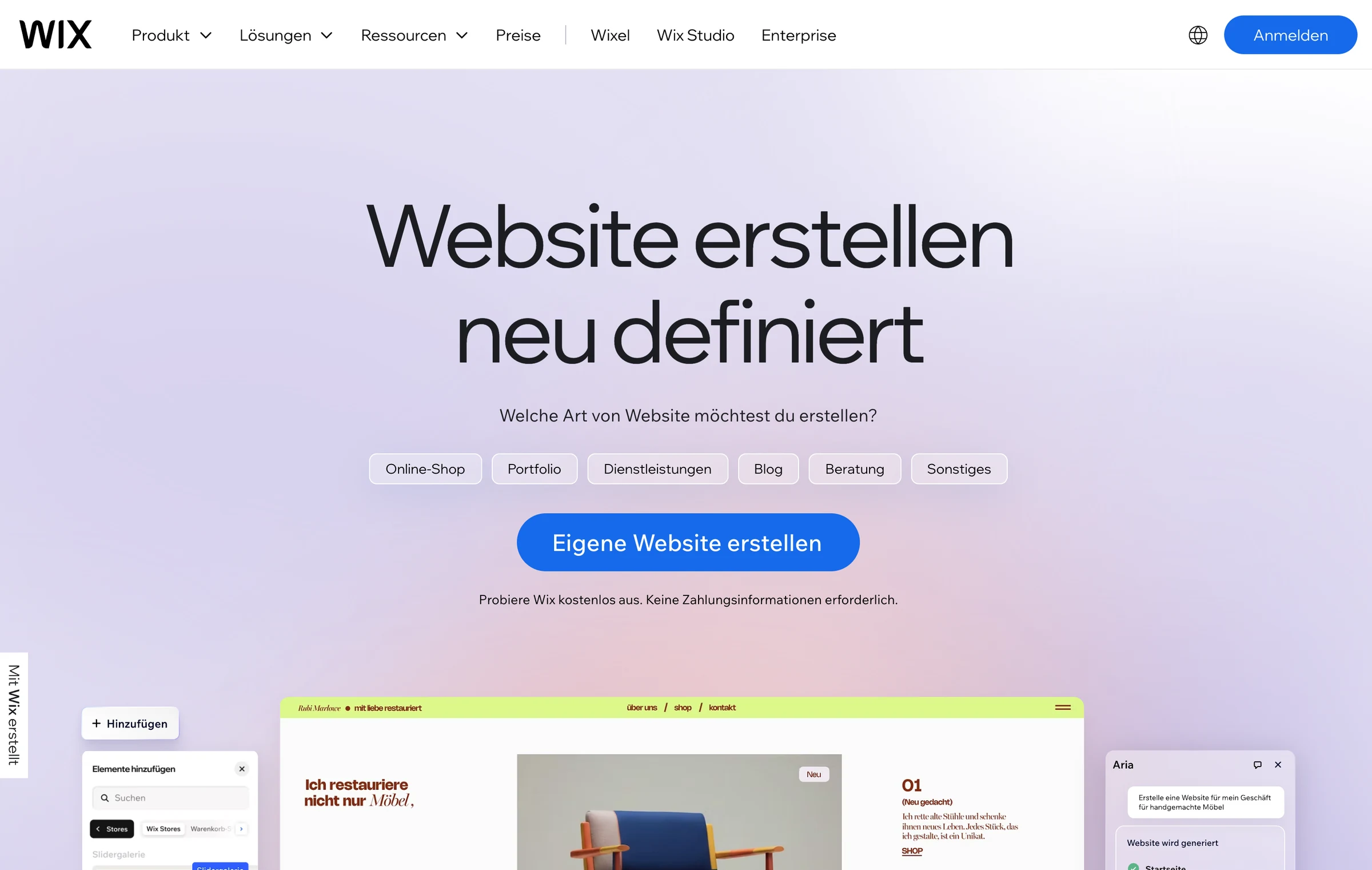
Wix is the ideal solution if you want to build a website quickly and easily and have neither the time nor the desire to dig into the details.
The tool gives you a website builder that leaves nothing to be desired. Besides a very good drag-and-drop builder, the backend offers extensive marketing features such as your own newsletter.
You can also set up your own shop with Wix in no time, and inventory management runs right in the backend.
Why might Wix be a better choice than Shopify?
Wix is a great beginner solution and incredibly simple to use. If you’re looking for a hybrid of website and e-commerce, or you already have a Wix website, the tool is a perfect fit.
Wix also scores on value for money.
- Ideal for beginners
- Drag-and-drop builder
- Good value for money
- Various plans available
- Customer accounts can be enabled for free
- Good support
- Limited range of features
- Only suitable for smaller shops
- Strongly geared toward the US market
2. WooCommerce
WooCommerce isn’t a standalone shop solution but a WordPress plugin.
You can install WooCommerce for free to add a wealth of e-commerce features to your site, which can be extended with paid add-ons if needed.
The great thing: many third-party providers are compatible with WooCommerce and make integration easy. For example, you can analyze your visitors' behavior with Google Tag Manager and record sales with email marketing tools like Mailchimp.
Why might WooCommerce be a better choice than Shopify?
If you already run a WordPress website and want to add a shop function to it, WooCommerce is the gold standard. The plugin blends seamlessly into your backend and hardly poses any challenges when you use it.
Another important plus is that there are no license costs.
- Free
- Extendable with premium add-ons
- Compatible with numerous third-party providers
- Large community for questions
- Blends seamlessly into WordPress
- Easy to use
- Also suitable for larger shops
- Isn’t legally safe for Germany without adjustments
- Can only be used together with WordPress
- No plugin support of its own
3. Squarespace

Squarespace was originally designed as a website builder that helps you create websites without writing a single line of code.
Almost ten years after its launch, the tool was expanded with extensive e-commerce features. You get automated customer accounts, analytics, marketing tools, discount coupons and much more.
In the Pro plan you can even sell a subscription model.
Why might Squarespace be a better choice than Shopify?
Squarespace offers a minimalist look with a large range of features. It’s especially suitable if you want to run a blog alongside your shop but don’t want to rely on WordPress.
It’s very easy to use, and you work with an excellent drag-and-drop builder.
- Good value for money
- Many features included in the entry-level plan
- Drag-and-drop builder
- Mature blogging function
- Express checkout possible
- Subscription models in the premium plan
- Good support
- Very minimalist
- No international shop possible
4. Jimdo

Jimdo is another website builder that I recommend for two reasons:
- There’s a free plan that’s wonderful for trying things out.
- The tool is child’s play to use, which makes it ideal for beginners and small shops.
There are three shop plans to choose from. They differ in their range of features and cost between €20 and €50 per month (incl. German VAT, billed annually).
What they all have in common is that with the drag-and-drop builder you quickly set up a shop with all the basic features, no prior knowledge needed.
Why might Jimdo be a better choice than Shopify?
Jimdo is the all-in-one beginner solution for the undemanding, and I mean that in a positive way. If you want to build a website including a shop, have little time and only offer a small product range, Jimdo fits very well.
- Free plan
- Very beginner-friendly
- Great value for money
- Drag-and-drop builder
- No transaction fees
- No sale of digital products
- Not suitable for medium-sized to large shops
- Important features are missing (e.g. shipping cost calculation)
5. Gambio
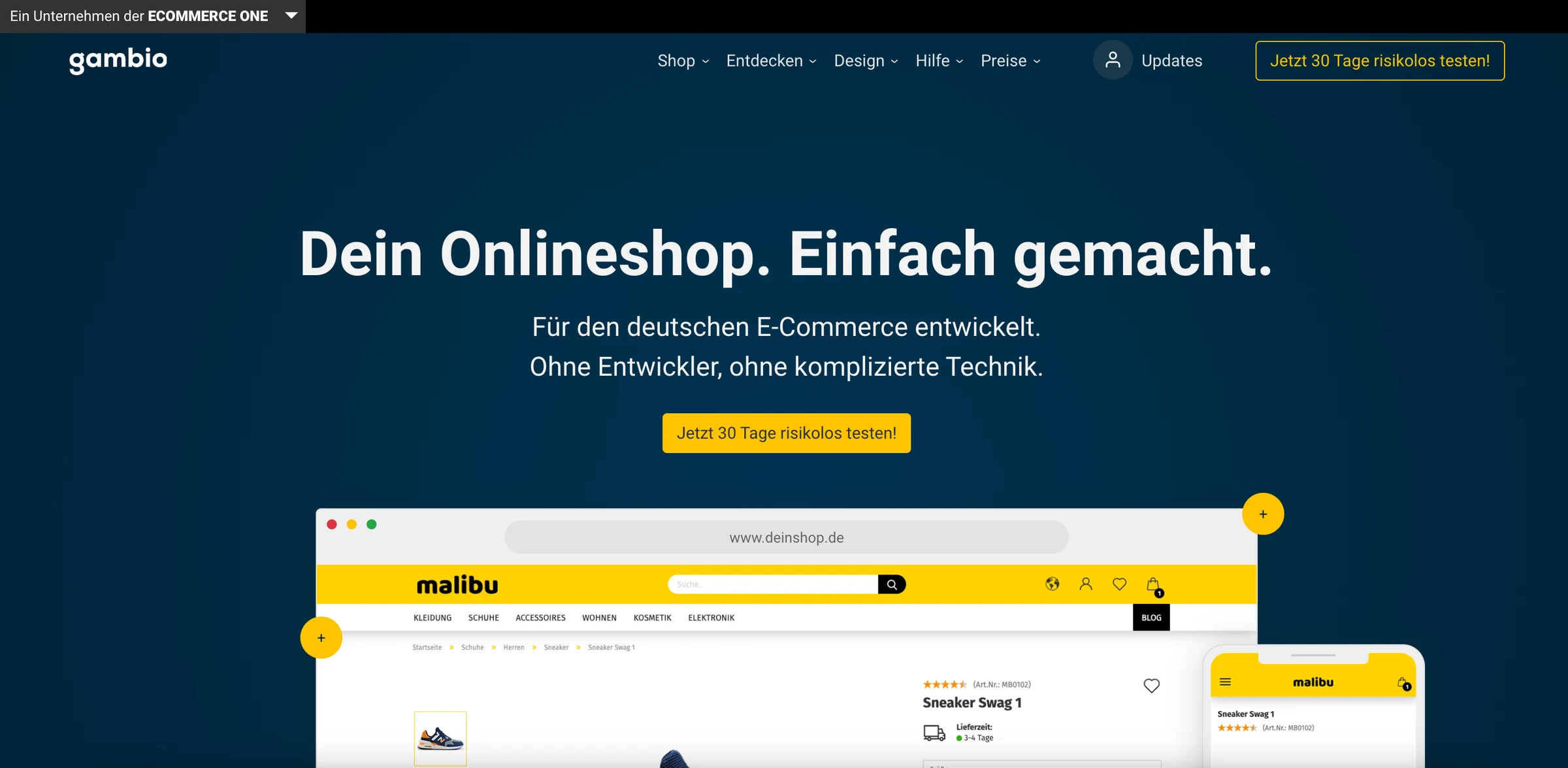
With Gambio, a setup assistant guides you through shop creation in seven steps. Right after registration you get a dummy shop with sample products.
In short: everything here is geared toward beginners.
For the design you can choose between five themes.
The backend, especially product creation, still has room for improvement, though. For example, there’s no product preview, and the settings menu looks confusing.
Why might Gambio be a better choice than Shopify?
Gambio is tailored to the German-speaking market, meets the local legal requirements and offers numerous shipping and payment features even in the smallest plan.
- Good value for money
- Attractive designs
- Free 14-day trial period
- Dummy shop
- Product presentation is legally compliant for Germany
- Extensive help section
- Setup assistant
- No product preview
- Sometimes very confusing
6. ALZURA Shop

Although ALZURA Shop has existed since 1998, it’s still an insider tip, despite its numerous features.
You create all content with a simple drag-and-drop builder and manage it in a modern CMS. Adding your products is well thought out too and causes hardly any friction.
The biggest plus is the technical design: the cloud solution is extremely fast and impresses with excellent performance.
Why might ALZURA Shop be a better choice than Shopify?
ALZURA Shop is a modern all-in-one solution that’s a bit leaner than Shopify. If you’re not planning a huge shop and standard features are enough, the tool is an interesting alternative.
- Very good value for money
- 3 different plans
- 30-day free trial
- Offline work possible
- Modern drag-and-drop builder
- Its own CMS
- Media management
- Very well thought-out product management
- Very high commission on orders in the Starter plan
- No extensions
7. Adobe Commerce (Magento)
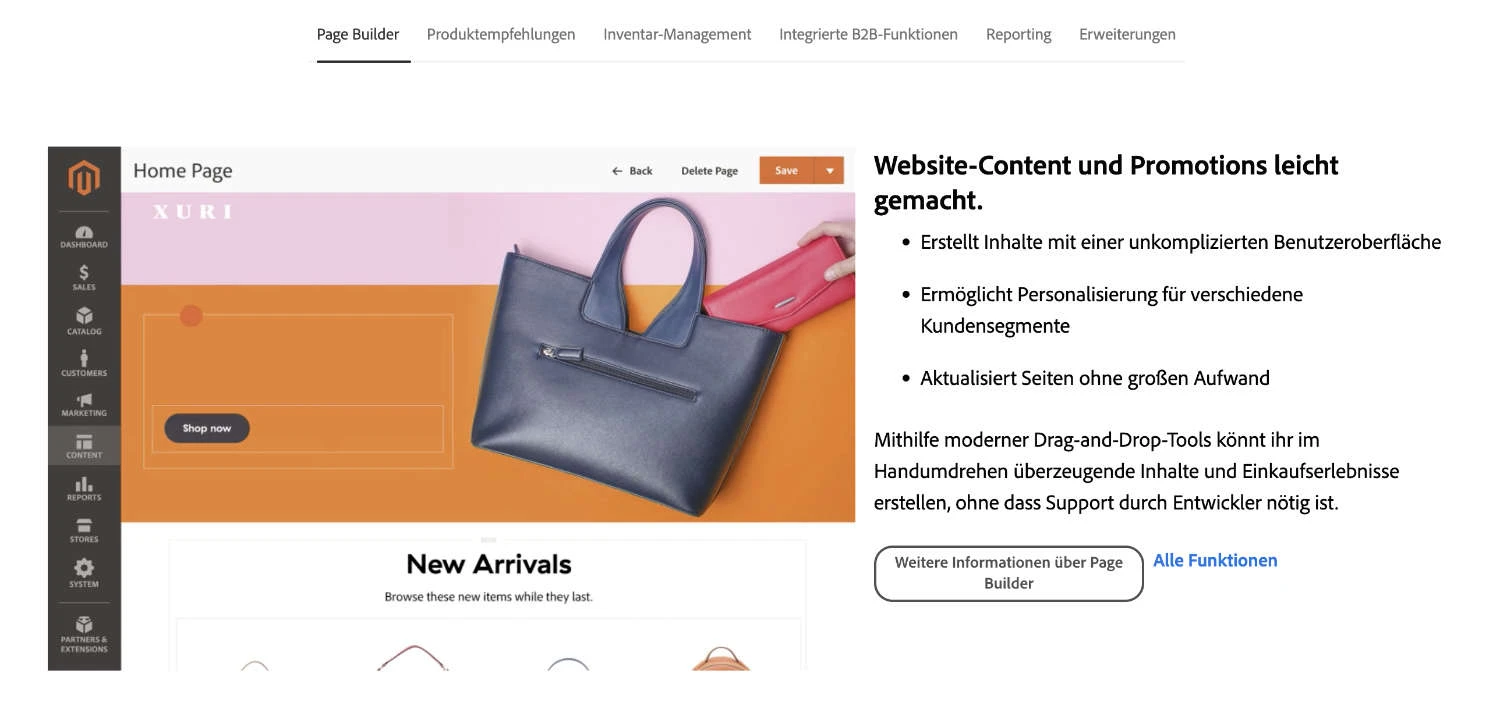
Adobe Commerce (formerly Magento) is most comparable to WooCommerce but offers an even larger range of features. The platform copes with gigantic product ranges and is therefore especially suited to large shops.
One downside: themes and extensions can get expensive quickly, since many of them aren’t free.
Why might Adobe Commerce be a better choice than Shopify?
If you’re already an Adobe customer and use the Adobe Cloud, Adobe Commerce can be the more sensible choice.
- Open source
- Free
- Large range of features
- A competent contact at Adobe
- Copes with large product ranges
- High system requirements
- Expensive plugins and themes
8. Weebly
Weebly, like Wix or Jimdo, is a website builder with a shop function.
The range of features is limited, however, which is why Weebly is hardly suitable for medium-sized and large shops.
For example, customers currently can’t create accounts, and there are only a few extensions.
Since the acquisition by Square in 2021, there’s hope for new features.
Right now, Weebly is a good choice for smaller sole proprietors with a manageable product range.
Why might Weebly be a better choice than Shopify?
Weebly impresses with its user-friendliness. Products are easy to add, and you can customize the design without any prior knowledge.
- Free trial possible
- Affordable entry
- Easy to use
- Great templates included
- Drag-and-drop editor
- Excellent blog function
- Transaction fees in the Starter plan
9. Ecwid
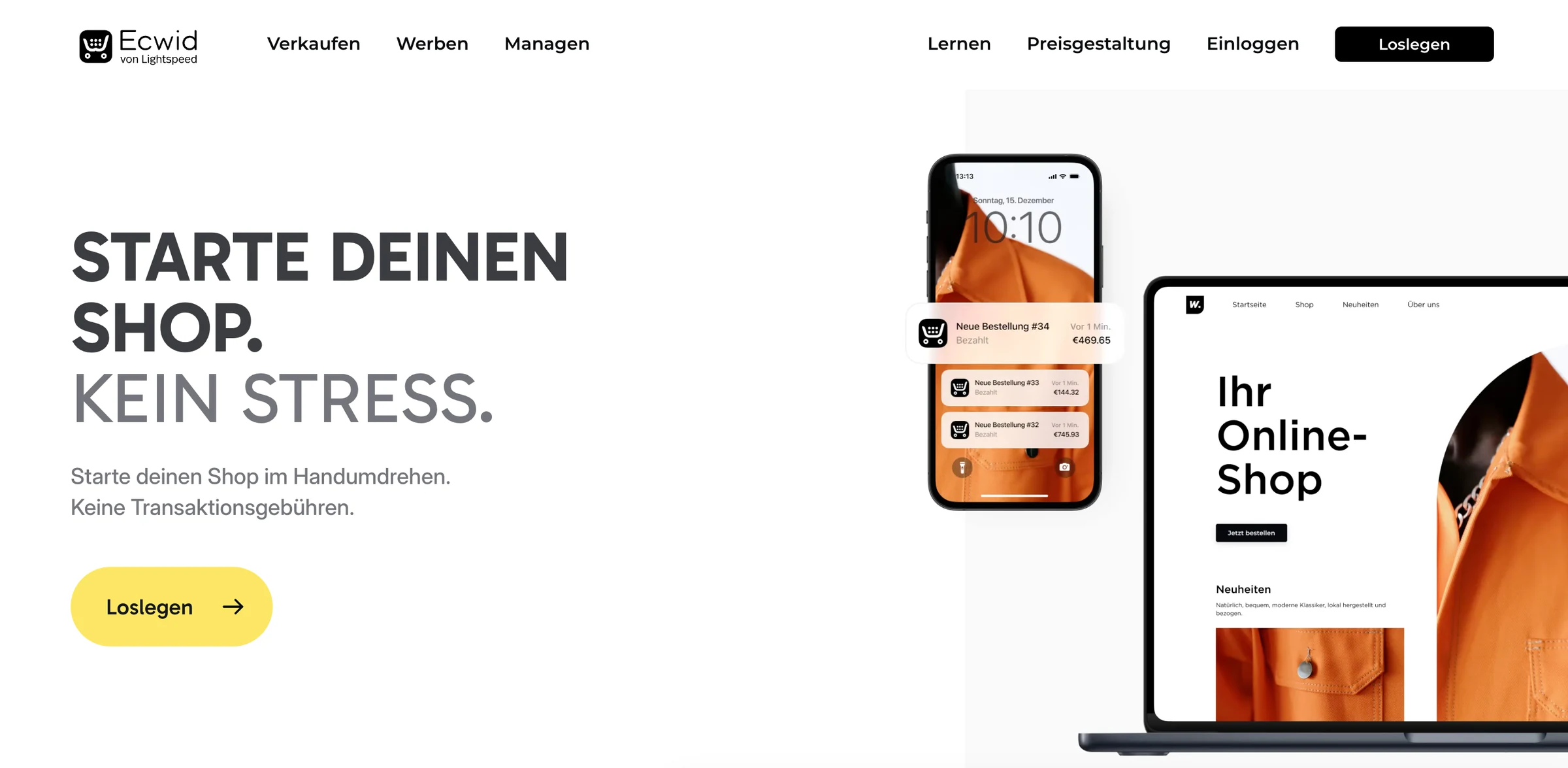
Ecwid isn’t a standalone shop solution but an extension for existing websites, and it works regardless of the system.
It’s easy to use, but the range of features is limited, and design options are restricted.
The affordable entry is a plus: up to ten products cost €5 per month, up to 100 products €29 per month (each excl. VAT, billed annually).
Why might Ecwid be a better choice than Shopify?
If you already run a website and don’t want to use WooCommerce or other plugins, Ecwid is worth a closer look.
- Affordable entry from €5 per month for up to 10 products
- Works with any website
- Many payment options possible
- Social media features already integrated
- Notification system for various events
- GDPR-compliant
- Shop management possible via smartphone
- Small range of features
- Few design customization options
- Premium plan is very expensive
10. Big Cartel

Big Cartel is the artistic alternative to Shopify. The shops look very high-quality and are ideal for painters, photographers or designers.
Although Big Cartel is a niche product, 2.5 billion US dollars have already been processed through the platform since 2005.
Thanks to the free Gold plan, with which you sell up to five products, you can start without risk.
Why might Big Cartel be a better choice than Shopify?
If you’re an artist, Big Cartel’s themes and designs fit your niche perfectly.
- Free plan
- Very gradual step-up between the other plans
- Artistic designs
- Clear backend
- No prior experience required
- Maximum of 500 products
- Design can only be customized to a limited extent
- No phone support
11. Simvoly
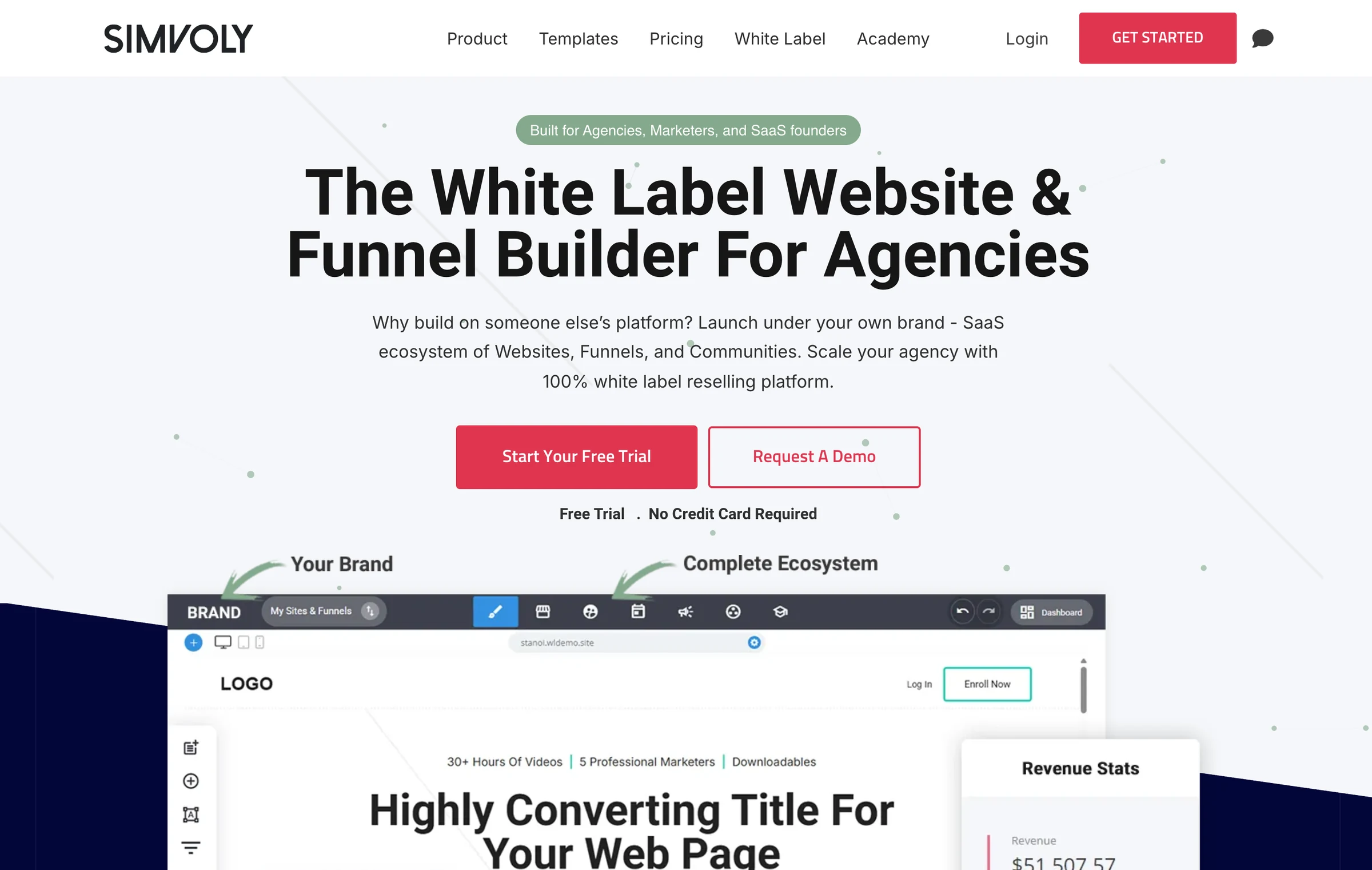
Simvoly is one of the younger shop solutions on the market, but it brings numerous features: an intuitive drag-and-drop builder that strongly reminds me of the Divi WordPress theme, A/B tests and 1-click sales.
One highlight is the sales funnels. You can set up upsells and downsells or redirect visitors in a targeted way after abandoned purchases. That will definitely increase your conversions.
Extensive analytics are already included, too.
Email marketing with if-then automations is integrated and is billed separately depending on the number of subscribers.
Why might Simvoly be a better choice than Shopify?
Simvoly delivers a worry-free package and combines many tools in one product. If you want to get started without a big setup but still use many features, Simvoly is an interesting option.
- Free trial possible
- Intuitive drag-and-drop builder
- Tidy backend
- A/B tests possible
- Sales funnels
- Analytics
- Express checkout
- Email marketing
- Very low price
- I can’t find any
12. PinnacleCart
PinnacleCart gives you shop software that you host on your own server. That makes you independent but requires powerful hosting.
Many integrations, such as Mailchimp or Facebook, come preinstalled, and more can be added, even if the selection is manageable.
Twelve templates are included, can be imported and are then easy to customize. Adding products is quick.
Why might PinnacleCart be a better choice than Shopify?
PinnacleCart allows any number of admins. If several developers are meant to work on your shop at the same time, that’s a big advantage.
- No transaction fees
- Can be canceled monthly
- 12 ready-made templates
- Clear backend
- Numerous payment options
- Important apps integrated
- High costs
- High system requirements
Conclusion
I’ve introduced you to twelve Shopify alternatives that each shine in different areas. To finish, I’ll show you four scenarios in which I’d reach for an alternative:
- Large number of products: With many products, Shopify quickly hits its limits. Here I’d advise Magento or WooCommerce.
- Blogging feature: If you also want to run a blog, Shopify doesn’t shine. In that case, WooCommerce in combination with WordPress is the better choice.
- Beginners: You don’t want to deal with the technology of building a shop and would rather see results as quickly as possible? Then website builders like Wix or Jimdo are ideal.
- All-in-one solution: While researching this article, Simvoly really impressed me. The tool offers a wealth of great features that I haven’t seen in any other shop solution.
FAQ
Here you’ll find answers to common questions about Shopify alternatives:
When is Shopify worth it?
Shopify is the top of the class among shop systems and combines beginner-friendliness with a very large range of features.
With apps you can extend the system as much as you like and tailor your shop exactly to your requirements.
What is the best Shopify alternative for dropshipping?
For dropshipping, the alternatives presented here that come closest are Wix or WooCommerce, if you don’t want to work with Shopify.
Even so, in this specific scenario I still recommend Shopify, because it has the most integrations and automations available.
Is there an open-source alternative to Shopify?
Yes, there is: WooCommerce.
If you already run a WordPress website, you can conveniently add your shop as a subsection or on a subdomain and benefit from plugins and a huge community.